
The Best Fluffy Pancakes recipe you will fall in love with. Full of tips and tricks to help you make the best pancakes.
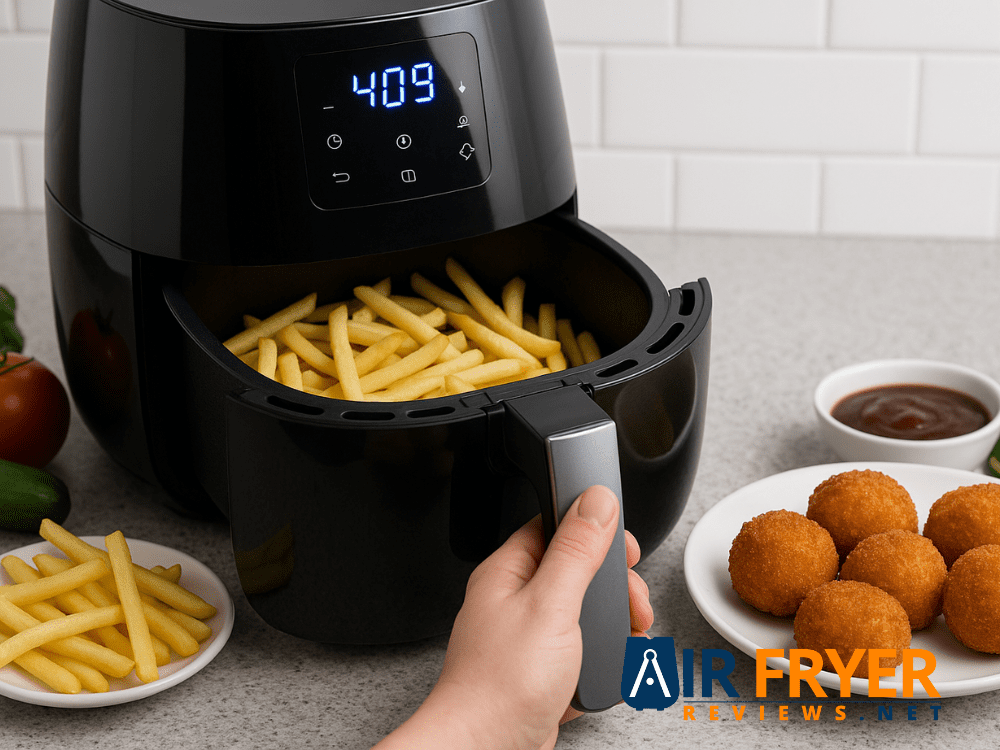

Soggy fries. Dry chicken. Uneven browning. Guesswork timings.
These are the most common reasons air fryers get pushed to the back of the counter.
In my own kitchen testing, I’ve found the issue is rarely the appliance it’s technique. This guide fixes those problems with clear steps the why behind each method and professional cues that focus on airflow heat control and moisture balance.
Contributing chefs emphasize two core principles:
- Airflow & spacing for even convection
- Moisture control (pat-drying, light oil use, brining when needed)
My role here is simple test these techniques repeatedly in real home kitchens and refine them until they’re reliable.
By the end of this guide, you’ll understand not just what to do but why it works.
How to Get Perfectly Crispy Results in an Air Fryer
If you remember only one section from this article make it this one.
1. Preheat (3-5 Minutes)
Always start hot.
Food should hit fully heated air immediately.
Why: A hot-start environment triggers faster surface browning and prevents early moisture buildup.
2. Pat Dry First
Surface moisture is the enemy of crispness.
- Pat proteins and vegetables dry.
- Toss with 1-2 teaspoons of oil per pound for even browning.
Why: Dry surfaces brown. Wet surfaces steam.
3. Single Layer Only
No stacking. No crowding.
Leave space between pieces so air circulates freely.
Why: Air fryers cook with moving heat. Block airflow and you lose crispness.
4. Cook Hot & Short
Most crispy foods thrive at:
375-400°F (190-205°C)
Shake or flip halfway through.
Why: Higher heat accelerates the Maillard reaction the chemical process responsible for golden-brown crust.
5. Rest 2-3 Minutes After Cooking
This step is overlooked.
Let food sit briefly before serving.
Why: Steam escapes. The crust firms up. Cutting too early traps moisture and softens texture.
The Science Behind It
Crisp air fryer results rely on three factors:
- Hot-start convection
- Dry surface area
- Unrestricted airflow
Rapid circulating heat + low surface moisture = faster browning and better texture.
Professional kitchen testing consistently confirms that airflow and moisture management matter more than brand differences.
What You’ll Get From This Guide
This isn’t theory it’s practical problem-solving.
You’ll learn:
- Quick fixes for sticking, sogginess, dryness and smoke
- Core techniques that work across proteins, vegetables and frozen foods like chicken tortilla filling recipes
- Reliable temperature ranges you can trust
- Simple troubleshooting checklists
- Prep habits that improve results without adding extra work
The goal isn’t perfection. It’s consistency.
The Air Fryer Advantage: Why We Love It
Air fryers deliver the crunch and color people expect from “fried” food while using far less oil cooking faster than a full-size oven and keeping cleanup simple. In my own testing the biggest difference isn’t just crispness it’s how manageable weeknight cooking becomes.
Dietitians and health organizations consistently note that air frying can reduce oil absorption compared with deep frying. That reduction supports lower overall fat intake while still maintaining texture and browning.
From a technical perspective the advantage comes down to chamber size and airflow. A compact, fan-driven cavity heats quickly and circulates hot air intensely around food. Less space to heat means shorter preheats and faster cooking cycles. Moisture evaporates rapidly encouraging browning without oil saturation.
Why Are Air Fryers So Popular?
Air fryers circulate hot air to mimic frying with a fraction of the oil. Foods come out crisp with less fat and the appliance typically preheats in minutes. For small batches, it often cooks faster than a conventional oven and may use less energy because it heats a smaller space.
Add easy cleanup no oil disposal, fewer splatters, removable nonstick baskets and the appeal becomes practical rather than trendy.
Health, Speed & Convenience at a Glance
| Benefit | Air Frying | Traditional Frying / Oven Roasting |
|---|---|---|
| Healthier Cooking | Uses significantly less oil food absorbs less fat compared with deep frying | Deep frying requires oil submersion oven roasting may need more added fat |
| Cooking Speed | Quick preheat (often a few minutes) shorter cook times for many foods | Longer preheat and generally longer cooking cycles |
| Crispness & Texture | Strong convection airflow promotes even browning with minimal oil | Deep frying creates crispness but adds fat ovens may require more oil or time |
| Energy Efficiency | Smaller cavity efficient for small meals | Heats a larger space less efficient for small portions |
| Cleanup | No oil disposal removable baskets simplify washing | Oil disposal (frying) and large trays increase cleanup |
Healthcare sources confirm reduced oil absorption compared with deep frying. Energy advisors note that air fryers can be cheaper to run than ovens for smaller meals due to shorter cook times and a smaller heated cavity.
When an Air Fryer Makes the Most Sense
If you’re cooking for one to two people preparing small batches or want crisp results with less oil and minimal cleanup a compact 5qt air fryer is a practical choice.
In structured kitchen testing, I consistently see three everyday advantages:
- Faster weeknight meals
- Lighter versions of crispy foods
- Less post-cooking mess
The appliance doesn’t replace every cooking method but for small, quick, health-forward meals like air fryer sausage patties, it delivers a strong balance of speed, texture and simplicity.
How Air Fryers Work: The Science Behind the Crisp
Air fryers are compact convection ovens. A heating element warms the chamber while a high-powered fan drives that heat across the food’s surface from multiple angles. The constant airflow evaporates surface moisture quickly allowing the exterior to dry and brown before the interior overcooks.
In repeated home testing, I’ve seen that most “air fryer failures” come from misunderstanding this airflow system not from the appliance itself.
Convection Technology
Rapid, forced air moves over every side of the food.
- Speeds up heat transfer
- Reduces the need for constant flipping
- Promotes more even browning
Because the chamber is smaller than a conventional oven, heat circulation is more concentrated and efficient.
The Maillard Reaction
Once the surface dries and reaches roughly 300-350°F (150-175°C) amino acids and sugars react to create deep color and savory flavor.
A light oil coating improves surface contact and promotes more uniform browning. This is why food turns golden and flavorful instead of pale and soft.
Why This Creates Crispiness
Crispness happens when:
Dry Surface + Hot Moving Air = Fast Crust Formation
Because surface moisture evaporates quickly the food spends less total time in heat. That shorter exposure helps the interior remain tender while the outside browns efficiently.
Professional kitchen insight consistently reinforces two factors:
- Proper spacing preserves airflow.
- Pat-drying plus a light oil coating accelerates browning without greasiness.
What Makes Air-Fried Food Crispy?
Crispness comes from rapid convection that dries the surface and triggers the Maillard reaction.
For reliable results:
- Preheat the chamber
- Pat food dry
- Use a light oil coating
- Space food properly
When hot air contacts the surface evenly a browned crust forms while the inside stays moist.
Common Air Fryer Types & Features
Basket-Style
- Most common design
- Ideal for singles, couples, small batches
- Easy shake-to-toss action
Oven-Style (Toaster-Oven Hybrids)
- Larger capacity
- Multiple racks
- Often include rotisserie or dehydrator functions
- Better suited for families and batch cooking
Digital vs. Analog Controls
Digital
- Precise temperature settings
- Presets and reminders
- Greater repeatability
Analog
- Simple dial operation
- Faster startup
- Fewer electronics but less precision
Wattage & Capacity
- Typical basket units range 1400-1800W
- Higher wattage recovers heat faster after adding food
- Capacity ranges from 2-6 quarts (larger for oven-style units)
Consider this 6-quart air fryer to choose size based on household needs. Higher wattage supports more stable heat especially important for crisp results.
Key Components & Why They Matter
| Component | Function | Importance for Results |
|---|---|---|
| Heating Element | Generates consistent heat | Drives browning and doneness stronger elements recover heat faster |
| High-Powered Fan | Circulates hot air | Essential for crispness prevents hot/cold spots |
| Cooking Basket/Tray | Holds food; usually perforated | Allows airflow underneath supports even browning |
| Temperature Control | Regulates heat | Prevents burning or undercooking fine-tunes texture |
| Timer | Sets cooking duration | Protects from overcooking improves repeatability |
| Air Vents | Release steam | Reduces sogginess keeps chamber in optimal browning range |
Why Understanding the Parts Matters
When you understand airflow, heat recovery and steam release troubleshooting becomes simple.
- Space food to improve convection
- Pat dry and oil lightly to enhance browning
- Preheat to shorten cook time
- Allow vents to release excess steam
Once you see the air fryer as a controlled convection system rather than a “mini deep fryer,” results become predictable and much easier to perfect.
Essential Pre-Cooking Mastery
If you want consistent crispness most of the work happens before the basket goes in. In my testing, these small prep steps make a bigger difference than adjusting temperature mid-cook.
1) Always Preheat Your Air Fryer
Why It Matters
Preheating saturates the chamber with steady heat so food hits hot air immediately. That fast surface dehydration jump-starts the Maillard reaction giving you even browning and better crunch in less time.
Expert Tip
Preheat 3-5 minutes at your target temperature.
For thick proteins or frozen foods lean closer to 5 minutes to help the unit recover heat after loading.
Chef note: A hot start protects crispness when the basket gets “shock-cooled” by cold food.
2) Pat Food Dry Before Oiling
Why It Matters
Surface water must evaporate before browning can begin. If the exterior stays wet, it steams leading to pale, soft results.
Expert Tip
Blot wings, potatoes and breaded items thoroughly with paper towels then oil.
Chef note: For chicken a simple dry brine (salt 30-90 minutes ahead) followed by another blot before oiling speeds up crisping and improves flavor.
3) Light Oiling for Crispness
Why It Matters
A thin, even film of oil improves heat contact, promotes uniform color and helps seasonings stick without greasiness or smoke.
Expert Tip
Use 1-2 teaspoons of oil per pound of food. Apply with a refillable oil sprayer/mister for even coverage. Avoid heavy pours excess oil can pool, smoke and soften crusts.
Pro move: Skip aerosol propellants. Fill a refillable mister with a high-heat oil.
4) Seasoning Strategy (How & When)
Before Cooking
Toss dry foods with salt and dry spices after oiling so they adhere evenly.
After Cooking
Add delicate herbs, citrus zest, flaky salt or glaze while the food is hot. Flavors bloom without burning.
For Breaded Items
Season the crumb mixture then finish with a light post-cook sprinkle to reinforce flavor.
5) Basket Preparation
Why It Matters
Proper prep reduces sticking and simplifies cleanup without blocking airflow.
Expert Tip
- Lightly oil the basket or
- Use perforated parchment or thin silicone liners for delicate items (fish, breaded cutlets).
Important: Never preheat with loose parchment. Add it only with food on top so it doesn’t lift into the heating element.
Pre-Cooking Steps for Perfect Results
- Preheat 3-5 minutes for an immediate hot-air sear.
- Pat food dry to prevent steaming and promote browning.
- Mist lightly with oil (1-2 tsp per pound) for even crispness.
- Season smartly spices before, fresh herbs after.
- Prep the basket with light oil or perforated liner (with food on top).
Quick Reference Table
| Pre-Cooking Step | Why It’s Essential | Actionable Tip for Perfection |
|---|---|---|
| Preheating | Stabilizes heat accelerates Maillard browning | Preheat 3-5 minutes at target temp |
| Patting Food Dry | Removes surface moisture that hinders crisping | Blot thoroughly before oiling/seasoning |
| Lightly Oiling Food | Promotes golden color and even texture | Use a mister for a thin even coat (1-2 tsp/lb) |
| Proper Seasoning | Maximizes flavor and crust development | Season after oiling add fresh herbs post-cook |
| Basket Preparation | Prevents sticking easier cleanup | Oil lightly or use perforated liners (with food on top) |
Real-World Test Example
During testing, I ran two identical batches of wings same time, same temperature.
- Without pat-drying: Pale, soft skin.
- With thorough blotting + light oil mist: Evenly browned, crackly skin.
In a repeat test, adding a 5-minute preheat improved browning speed and reduced total cook time keeping the interior juicier.
The takeaway is simple:
Preheat, dry, oil lightly, space properly.
Core Air Frying Techniques for Success
Once pre-cooking prep is dialed in these core techniques determine whether your results are crisp and consistent or pale and uneven. In my testing, mastering these habits eliminates most common complaints within the first few cooks.
Don’t Overcrowd the Basket
Why It Matters
Overcrowding blocks airflow and traps steam. Trapped steam softens surfaces so browning stalls and the interior may overcook while the exterior stays pale.
Air fryers cook with moving heat if air can’t circulate, crispness suffers.
What to Do
- Cook in single layers.
- If food touches or overlaps run two faster batches rather than one overcrowded batch.
Practical Rule: Leave roughly 25% of the basket area open so hot air can circulate freely.
Shake or Flip Mid-Way
Why It Matters
Even with good airflow, the side resting against the basket warms differently than the exposed side. Shaking or flipping equalizes heat exposure and improves color.
What to Do
- Fries, tots, small vegetables → Shake halfway.
- Cutlets, chops, larger pieces → Flip once with tongs.
Simple cue: When the kitchen starts to smell lightly toasty, it’s often time to shake or flip.
Check Doneness Early
Why It Matters
Air fryers often cook faster than ovens. Waiting for the full printed recipe time increases the risk of dryness.
What to Do
- Start checking 2-4 minutes early on your first run.
- Use an instant-read thermometer for proteins.
Temperature targets:
- Chicken thighs: 74°C / 165°F
- Pork chops: 63°C / 145°F (rest 3 minutes)
- Salmon (medium): 50-52°C / 122-125°F
Logging your final internal temperature the first time you cook a cut makes future batches predictable.
Adjust Temperature & Time Thoughtfully
Why It Matters
Basket size, wattage and food thickness affect heat transfer. Small adjustments prevent burning or undercooking.
What to Do
- For a new recipe or unfamiliar unit:
- Start 10-15°C (25°F) lower
- Cook 2-3 minutes shorter
- Finish based on color and internal temperature
Technique balance:
- Lower and slightly longer for delicate vegetables.
- Hot and shorter (190-205°C / 375-400°F) for breaded or high-moisture foods that need fast surface drying.
Apply Oil Strategically
Why It Matters
A thin, even film of oil improves surface contact, browning and crunch. Too much oil pools, smokes and softens crusts.
What to Do
- Use a refillable oil mister.
- Target 1-2 teaspoons per pound of food.
- For longer cooks a light mid-way respray can restore sheen and enhance final color.
Quick Technique Summary
- Leave space for airflow.
- Shake or flip once halfway.
- Check early don’t trust default times blindly.
- Adjust temperature gradually.
- Oil lightly and evenly.
When these five habits become routine air frying shifts from guesswork to repeatable results.
How to get consistent results in an air fryer?
Consistency comes from controlling airflow, moisture, and timing not guessing. In my testing, the difference between “good” and “reliable” results is usually just a few small habits done every time.
The Core Formula
- Cook in single layers to keep airflow strong.
- Shake or flip halfway for even color.
- Start checking a few minutes early using an instant-read thermometer.
- Adjust temperature and time the first time you try a recipe.
- Use a light oil mist enough to brown not enough to smoke.
These principles align with professional airflow and moisture control best practices and translate directly into repeatable results.
Technique Quick-Guide
| Technique | Purpose & Impact | Best Practice & When to Apply |
|---|---|---|
| Batch Cooking | Preserves airflow prevents steaming | Cook in single layers essential for fries, wings, vegetables |
| Shaking / Flipping | Promotes uniform browning | Shake halfway for small items flip larger cuts once |
| Monitoring Doneness | Prevents dryness ensures safety | Check early use an instant-read thermometer |
| Temperature Adjustment | Matches food type & unit power | Start slightly lower/shorter on first run fine-tune |
| Oil Application | Supports browning & flavor | Light, even mist re-mist lightly mid-cook if needed |
Real-World Test Example
Early on, I tested breaded zucchini two ways:
- Crowded batch: Steamed, patchy crust.
- Two smaller batches + midway shake: Golden, crisp end-to-end.
In a repeat run, I started 10°C lower then finished hotter for the final 2 minutes. The interior stayed tender while the crust snapped cleanly.
The biggest improvement? Leaving roughly a quarter of the basket free for airflow.
Bottom Line
Consistent air frying isn’t about chasing the perfect preset. It’s about:
- Protecting airflow
- Managing moisture
- Checking doneness early
- Adjusting with intention
Once those habits are automatic results become predictable and repeatable.
Achieving Perfect Textures: Crispy, Tender, Juicy
Great air frying isn’t just about cooking through it’s about texture contrast. For crispy breakfast pies, achieving a Crisp outside. Tender or juicy inside. That balance comes from controlling surface moisture, airflow and finishing temperature.
The Quest for Crispy
Why It Works
Crispness forms when:
- The surface is dry
- A thin oil film improves heat contact
- Fast-moving hot air dehydrates the exterior quickly
Dryness accelerates the Maillard reaction. Oil enhances even browning. Strong airflow finishes the crust.
How to Get Extra Crispy Results
- Pat food completely dry
- Preheat 3-5 minutes
- Apply 1-2 teaspoons oil per pound (misted, not poured)
- Cook at 375-400°F (190-205°C)
- Shake or flip halfway
Spacing and a hot preheat protect crispness by accelerating surface dehydration.
Keeping It Tender and Juicy
Texture success isn’t just about crust it’s also about knowing when to stop cooking.
Pull at Target Temperatures
Use an instant-read thermometer and rest 3–5 minutes after cooking.
Temperature Guide:
- Chicken thighs: 165°F / 74°C
- Chicken breast: 160°F / 71°C (carryover to 165°F)
- Pork chops: 145°F / 63°C + 3-minute rest
- Salmon (medium): 122-125°F / 50-52°C
Resting allows juices to redistribute instead of spilling out.
Balancing Crisp Outside + Tender Inside
Two reliable methods:
Hot Start Method: Start hot to set the crust quickly.
Reverse-Style Method (Thick Cuts): Start lower to cook through gently. Finish with a short hot blast for exterior browning. This prevents overcooked interiors.
Ingredient Spotlight: Tricky Foods, Proven Fixes
Delicate Battered Fish
Problem: Batter slips, sticks or stays pale.
Solution:
- Lightly pre-freeze battered fillets 15-20 minutes
- Use thin batter or dredge (flour → egg → fine crumb)
- Cook hot and short 380-400°F (193-205°C) for 6–10 minutes
- Flip once
- Mist lightly after flipping if needed
Use perforated parchment to reduce sticking without blocking airflow.
Melting Cheese
Problem: Runs before browning messy cleanup for crescent rolls pizza stuffing add cheese during last 1-3 minutes.
Solution:
- Add cheese during last 1-3 minutes
- Use parchment liners for open-face melts
- Choose browning-friendly cheeses (provolone, low-moisture mozzarella, cheddar)
- Cook at 350-375°F (175-190°C)
Chilling topped items 5 minutes before cooking helps cheese soften more gradually.
Leafy Greens & Delicate Vegetables
Problem: Dry out or scorch for stuffed mushrooms specific techniques apply.
Solution:
- Light oil
- Lower temps: 300-340°F (150-170°C)
- Shorter times with frequent shakes
- For kale chips: pull at 4-7 minutes once edges crisp
A teaspoon of water in the drawer (below basket) can temper excessive drying without steaming the food.
Oil Method Observation
In back-to-back testing switching from brushing 1 tablespoon per pound to misting 1-2 teaspoons per pound reduced visible smoke and residue while maintaining equal or better browning.
Less oil = Cleaner Crisp.
Texture Playbook: Temps, Times & Pitfalls
| Desired Texture | Food Examples | Key Techniques | Example Temps & Times* | Common Pitfalls |
|---|---|---|---|---|
| Super Crispy | Fries, wings | Pat dry, mist oil, single layer, hot preheat, shake/flip | Fries: 380-400°F, 14-20 min • Wings: 390-400°F, 18-26 min | Overcrowding, excess oil, no preheat |
| Tender Interior | Chicken breast, pork chops | Pull at correct temp, rest, consider lower-then-finish-hot | Breast: 360-375°F, 12-18 min • Pork: 360-380°F, 10-16 min | Too hot, too long, no thermometer |
| Juicy | Steak, chicken thighs | Light oil, ideal doneness, brief rest | Steak (1 in): 390-400°F, 8-12 min • Thighs: 375-390°F, 16-22 min | Cutting immediately after cooking |
| Golden Brown | Veg, breaded cutlets | Even oil, adequate shaking, finish hot if needed | Cutlets: 380-400°F, 10-14 min • Veg: 360-380°F, 10-15 min | Low temp, uneven oiling |
*Times vary with thickness, starting temp, wattage and basket style. Start low finish to color and internal temperature.
Pro Sequencing to Nail Texture
- Preheat 3-5 minutes
- Dry → oil → season
- Single layer (liner only if needed)
- Shake or flip at midpoint
- Measure doneness for proteins
- Rest briefly before serving
Final Texture Takeaway
Crunch depends on airflow and dryness.
Juiciness depends on timing and temperature control.
Troubleshooting Common Air Fryer Problems: Myth Busters
Many air fryer frustrations come from assumptions not from the appliance itself. Clearing up a few common myths can immediately improve results and confidence.
Myth 1: You Don’t Need Any Oil in an Air Fryer
Reality: A light oil mist improves heat contact, color and crunch especially for fresh foods.
While air fryers use far less oil than deep frying completely skipping oil can lead to pale or dry results. A thin coating helps conduct heat more evenly across the surface and promotes browning.
Best Practice: Use 1-2 teaspoons per pound applied with a refillable oil mister. This is enough to enhance crispness without causing pooling or smoke.
Too much oil softens crusts. Too little can stall browning. The balance matters.
Myth 2: All Foods Cook the Same in an Air Fryer
Reality: Moisture content, thickness, coating type and fat levels all change how heat transfers.
- High-moisture vegetables need more surface drying.
- Thick proteins require internal temperature monitoring.
- Breaded foods benefit from hotter starts.
- Fatty cuts may cook faster due to natural rendering.
Smart Approach: Start slightly lower in temperature for new foods then finish to color and internal temperature. Adjust spacing based on density and size.
Uniform technique does not mean identical settings.
Myth 3: Air Fryers Are Only for Frozen Foods
Reality: While frozen foods cook well air fryers excel far beyond that.
They handle:
- Small-batch baking
- Fresh vegetables
- Proteins
- Reheating leftovers
- Breaded or coated dishes
Results improve significantly when you combine:
- Proper preheating
- Light, even oiling
- Single-layer spacing
The appliance isn’t limited technique determines versatility.
Bottom Line
Most air fryer “problems” aren’t mechanical flaws. They’re adjustment issues:
- Add light oil, don’t skip it entirely.
- Modify temperature and time based on food type.
- Use airflow principles consistently.
When expectations align with how convection works, results become predictable and much more satisfying.
Solving Your Air Fryer Headaches: Problems & Solutions
Most air fryer frustrations trace back to airflow, moisture, oil balance or temperature control. Fix those variables and results improve fast.
Food Cooking Unevenly
Likely Causes:
- Overcrowding
- No shake or flip
- Irregular food sizes
Fix It (Step-by-Step)
- Spread food in a single layer with about 25% open space.
- Shake or flip at the midpoint.
- Cut ingredients uniformly for even thickness.
- If still pale at halfway increase temperature by 10-15°C (25°F).
Chef Cue: The “open space rule” prevents steam pockets that stall browning.
Food Sticking to the Basket
Likely Causes:
- No oil
- Sticky coatings
- Worn nonstick surface
Fix It (Step-by-Step)
- Preheat the empty basket 3-5 minutes.
- Mist food lightly with oil. For delicate coatings mist the basket too.
- Use perforated parchment or thin silicone liners for fragile items.
- Avoid metal utensils if coating is damaged. Replace baskets that are flaking.
Air fryer accessory kits (perforated liners, thin silicone mats) and non-abrasive brushes make maintenance easier.
Soggy Results
Likely Causes:
- Excess moisture
- Crowding
- Low heat
Fix It (Step-by-Step)
- Pat food completely dry before oiling.
- Cook in batches don’t stack.
- For crisping, cook hotter and shorter 190-205°C / 375-400°F.
- Always preheat for a hot start.
Chef Cue: Dry-brining chicken then blotting again before cooking speeds surface crisping.
Excessive Smoke or Unpleasant Odors
Likely Causes:
- Too much oil
- Fatty drippings
- Residue on heating element
Fix It (Step-by-Step)
- Reduce oil to 1-2 teaspoons per pound.
- Trim excess fat. Use a liner for very fatty foods.
- Clean basket, drawer and heating element after cooling.
- For lingering odors run at 180°C / 350°F for 3-5 minutes with a slice of lemon in the basket then clean again.
Food Drying Out
Likely Causes:
- Overcooking
- Temperature too high
- No resting period
Fix It (Step-by-Step)
- Check food 2-4 minutes early.
- Drop temperature by 10–15°C (25°F) and extend slightly if needed.
- Use an instant-read thermometer for accuracy.
- Rest meats 3-5 minutes before slicing.
Logging internal temps the first time helps dial in perfect repeat results.
Breading or Batter Turning Soggy
Likely Causes:
- High surface moisture
- Thick wet batter
Fix It (Step-by-Step)
- Pat food dry thoroughly.
- For battered fish pre-freeze 15-20 minutes to set coating.
- Use thin batter or fine crumbs.
- Start hot 190-205°C / 375-400°F to set exterior quickly.
- Flip once and mist lightly only if needed.
How to Fix Common Air Fryer Problems (Quick Summary)
- Uneven cooking: Single layer, shake/flip halfway, cut evenly.
- Sticking: Preheat, light oil mist, perforated liners, gentle cleaning.
- Soggy food: Pat dry, cook hotter, avoid stacking, preheat first.
- Smoke/odors: Reduce oil, trim fat, clean thoroughly.
- Dry food: Check early, lower temp, use thermometer, rest meats.
Troubleshooting Table (Quick Reference)
| Problem | Potential Causes | Actionable Solutions |
|---|---|---|
| Food Not Crispy Enough | Crowding, moisture, low oil, low temp | Batch cook, pat dry, light oil mist, raise temp, preheat |
| Food Sticking | No oil, damaged coating | Oil mister, perforated liners, preheat basket |
| Uneven Cooking | Overcrowding, no flipping | Single layers, shake/flip midway, uniform cuts |
| Excessive Smoke | Too much oil, fatty foods | Reduce oil, trim fat, clean element |
| Food Drying Out | Overcooking, high heat | Check early, lower temp, thermometer, rest |
| Soggy Breading | Moisture, thick batter | Pat dry, thin coating, hot start |
Real-World Testing Insight
Switching from brushing 1 tablespoon oil per pound to misting 1-2 teaspoons per pound on breaded cutlets delivered equal browning with less visible smoke and no oily residue. Pairing that with stricter single-layer spacing improved uniform color edge-to-edge.
Cleaning and Maintenance Guide
Regular cleaning prevents odors, smoke and flavor carryover while protecting nonstick coatings and heating efficiency. A clean unit heats faster, browns more evenly and lasts longer.
Even a thin film of oil on the basket or heating element can create smoke and dull crispness. Stale grease can also transfer off-notes to delicate foods.
How Do You Clean an Air Fryer Properly?
- Unplug and cool completely.
- Remove basket and pan wash in warm, soapy water with a non-abrasive sponge.
- Wipe the interior and exterior with a damp cloth.
- When fully cool, brush residue off the heating element and wipe it gently with a barely damp cloth.
- Dry all parts completely before reassembly.
- Use non-abrasive tools only to protect the coating.
Step-by-Step Cleaning Process (After Each Use)
1. Unplug and Cool Down
Safety first. Heat + water is a bad mix. Cooling protects both you and the coating.
2. Disassemble
Remove basket, tray and drawer/pan.
3. Wash Basket and Pan
Use warm, soapy water with a soft sponge or nylon brush.
Rinse thoroughly and dry completely.
4. Clean Interior Cavity
Wipe with a damp cloth and a drop of mild detergent.
Remove splatters before they harden.
5. Address the Heating Element
- Ensure unit is unplugged and fully cool.
- Tilt gently if needed.
- Use a soft brush to loosen crumbs.
- Wipe with a lightly damp cloth.
- Dry fully.
- Never pour water inside.
6. Exterior Wipe-Down
Use a damp cloth only.
Keep moisture away from vents and controls.
7. Reassemble and Air-Dry
Leave the basket slightly ajar for 10-15 minutes to ensure complete dryness.
Product tip: A non-abrasive cleaning brush designed for air fryer baskets helps preserve the nonstick surface and reduces aggressive scrubbing.
Deep Cleaning Schedule
Monthly (heavy users) or Quarterly (light users):
- Soak basket and pan 10-20 minutes in warm, soapy water.
- Use a soft brush to lift polymerized grease.
- For stubborn residue apply a baking soda + water paste, wipe gently, rinse thoroughly.
- Inspect heating element and upper housing remove baked-on splatter with a soft brush.
- Check silicone feet, liners and accessories. Replace cracked or warped parts.
Consistent maintenance prevents smoke and scorching that can sabotage texture.
In testing, baskets cleaned immediately after use produced noticeably less odor at the next preheat compared with baskets left overnight.
Cleaning Matrix
| Cleaning Area | Frequency | Method & Tools | Important Considerations |
|---|---|---|---|
| Basket & Pan | After every use | Warm soapy water, soft sponge/brush | Cool first avoid steel wool |
| Heating Element | Monthly / as needed | Soft brush, barely damp cloth | Unplug; never immerse dry fully |
| Interior Cavity | Weekly / as needed | Damp cloth + mild detergent | Wipe splatters promptly |
| Exterior | Weekly / as needed | Damp cloth | Avoid moisture in vents |
| Accessories | After every use | Follow manufacturer guidance | Dry thoroughly to prevent corrosion |
Best Practices and Safe Agents
Use:
- Microfiber cloths
- Cellulose sponges
- Soft nylon brushes
Avoid:
- Steel wool
- Abrasive powders
- Oven cleaners
- Chlorine bleach
For tough grease, warm water soaking and baking soda paste are usually sufficient.
If food starts sticking more than usual residue buildup may be the cause. Clean thoroughly before assuming the nonstick coating has failed.
Practical Results You’ll Notice
- Wiping the heating element every few cooks reduces smoke during high-temperature runs.
- Fully drying the basket before preheating prevents steaming that softens crusts.
Skipping cleaning after a fatty cook often leads to smoke and flavor carryover during the next preheat. A full clean of basket, pan and element restores neutral aroma and crisp performance immediately.
When converting recipes, think in terms of airflow, heat transfer and moisture control.
An air fryer has:
- A compact chamber
- Intense direct heat
- Constant forced convection
That means food browns faster and moisture evaporates quicker than in a traditional oven. Adjustments prevent over-browning or drying out before the interior finishes cooking.
Key Conversion Principles (Field-Tested)
1. Temperature Adjustment
Reduce oven temperature by 25-50°F (15-30°C).
Why: The concentrated airflow browns surfaces more aggressively.
Lowering the temperature prevents the exterior from darkening too quickly.
Example: Oven recipe calls for 400°F → Start at 350-375°F in the air fryer.
2. Time Adjustment
Start with 20-30% less cooking time.
Air fryers cook faster due to compact heat circulation.
Example: 30-minute oven recipe → Start checking at 20-24 minutes.
Always check early on your first run then finish to:
- Color
- Texture
- Internal temperature (for proteins)
3. Oil Strategy
Use far less oil than deep frying but don’t skip it entirely.
- Apply a light even mist
- Aim for 1-2 teaspoons per pound
- Avoid heavy brush-on coatings
A thin oil film improves browning without causing smoke or sogginess.
4. Batch Cooking
Air fryers depend on strong airflow.
- Cook in single layers
- Avoid stacking
- Leave some open space for circulation
Overloading turns convection into steaming.
Quick Conversion Formula
| Traditional Oven | Air Fryer Starting Point |
|---|---|
| Temperature | Reduce by 25-50°F (15-30°C) |
| Cooking Time | Reduce by 20-30% |
| Oil | Light mist only |
| Arrangement | Single layer, spaced |
Example Scenario
Oven chicken tenders:
- 400°F for 20 minutes
Air fryer adjustment:
- 375°F for 14-16 minutes
- Flip halfway
- Light oil mist before cooking
Check internal temperature and finish briefly if needed.
Why This Works
- Lower temp prevents surface over-browning.
- Shorter time accounts for faster heat transfer.
- Oil mist improves crust formation.
- Spacing preserves convection power.
Bottom Line
To convert oven recipes:
- Lower the temperature by 25-50°F (15-30°C)
- Reduce cooking time by 20-30%
- Use a light oil mist
- Cook in single layers
Small adjustments, early checking and airflow awareness turn almost any oven recipe into a reliable air fryer version.
Air Fryer Recipe Transformation Lab
Below are practical rewrites of common favorites using tested temperature and time adjustments. Always confirm doneness with an instant-read thermometer and adjust for thickness, wattage and basket size.
Oven-Roasted Chicken Thighs → Air Fryer
Original (Oven):
400°F / 200°C, 30-35 minutes
Air Fryer Version:
375°F / 190°C, 18-22 minutes
Flip once halfway
Keys to Success:
- Pat dry
- Light oil mist
- Single layer
- Rest 3-5 minutes
Pull at 165°F / 74°C and rest so juices stay in the meat not in the basket.
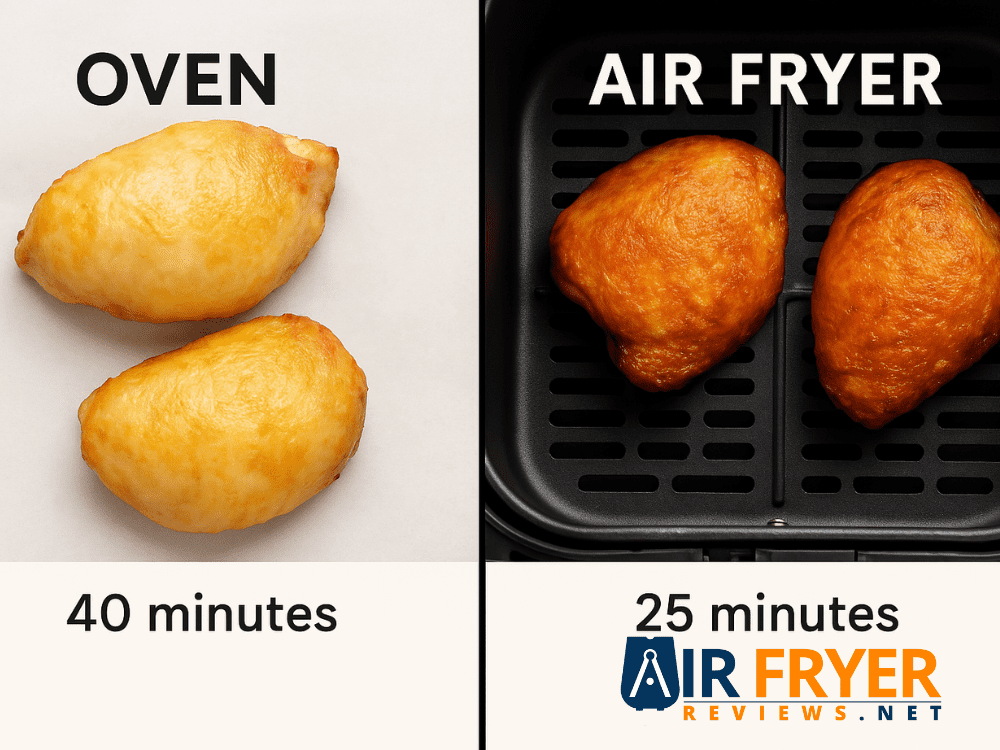
Side-by-side testing consistently shows air-fried thighs browning faster with deeper surface crispness when spacing is maintained.
Deep-Fried Spring Rolls → Air Fryer
Original (Deep Fry):
350°F / 175°C oil bath
Air Fryer Version:
380°F / 195°C, 10-15 minutes
Flip halfway
Light oil spray on wrapper
Keys to Success:
- Don’t crowd
- Shake once if small
- If pale at 10 minutes finish 2-3 minutes hotter
Mist the rolls not the basket for even sheen without oil pooling.
Air frying reduces oil dramatically while maintaining a crisp wrapper when airflow is preserved.
Baked Potatoes → Air Fryer Crispy Potatoes
Original (Oven):
400°F / 200°C, ~60 minutes
Air Fryer Version:
380°F / 195°C, 35-45 minutes
Flip halfway
Prick skins
Light oil + salt
Keys to Success:
- Choose even-sized potatoes
- If skins lack snap finish 3-5 minutes at 400°F / 205°C
Breaded Chicken Cutlets (Pan-Fry) → Air Fryer
Original (Pan Fry):
Shallow oil, 6-8 minutes per side
Air Fryer Version:
385-400°F / 196-205°C
10-14 minutes
Flip once
Mist crumbs lightly
Technique Notes:
- Fine crumbs adhere better
- If underside is pale after flip a light re-mist helps color
Switching from brush-on oil to a light mist reduces smoke and residue while maintaining browning.
Conversion Matrix (Quick Reference)
| Original Method | Example Dishes | Air Fryer Temp | Air Fryer Time | Key Technique | Notes |
|---|---|---|---|---|---|
| Oven Baking/Roasting | Chicken breast, veg | Reduce 25-50°F (15-30°C) | Reduce 20-30% | Pat dry, light oil, single layer | Check internal temp early |
| Deep Frying | Fries, fish | Similar or slightly higher (375-400°F) | Reduce 30-50% | Light oil mist, batch cook | Avoid thick wet batters |
| Pan Frying | Shrimp, tofu | Similar (350-380°F / 175-193°C) | Reduce 15-25% | Minimal oil, single layer | Press tofu pull shrimp at opaque |
On first runs, begin checking 2-4 minutes early. Finish to color and internal temperature.
Pro Tips to Speed Up Conversions
- Scout the weak link: If crust is ready but interior lags, start lower next time and finish hot.
- Use your thermometer:
- Chicken breast ~160°F / 71°C (carryover to 165°F / 74°C)
- Audit thickness: Thicker cuts may need +3-6 minutes.
- Record what works: Keep a simple note of cut, temp, time and flip point for repeat success.
Small, deliberate adjustments turn traditional recipes into reliable air fryer versions without guesswork.
Air Fryer Safety Guidelines
A few simple habits prevent overheating, smoke and electrical hazards and they keep your unit performing at its best. Treat your air fryer like a compact, powerful oven give it space, manage grease and respect the heat.
What Are the Key Air Fryer Safety Rules?
- Place the unit on a heat-resistant, open surface.
- Use a dedicated wall outlet.
- Never overfill the basket.
- Keep away from flammable materials.
- Manage grease buildup.
- Never use water on smoke or flames.
- Unplug before inspecting or cleaning.
- Allow the unit to cool fully before handling.
These habits reduce risk and improve cooking consistency.
Core Safety Do’s and Don’ts
Placement
- Leave several inches of clearance on all sides and above exhaust vents.
- Use a flat, stable, heat-resistant surface.
Avoid placing under low cabinets during operation or tight against walls.
Power & Cords
- Plug directly into a dedicated outlet.
- Inspect cords regularly for nicks or heat damage.
Avoid extension cords and power strips which can overheat under load.
Overfilling
- Respect maximum fill lines and weight limits.
- Cook in batches rather than stacking.
Overpacking blocks airflow and increases fire risk.
Flammables
- Keep away from curtains, paper towels, aerosols and solvents.
- Avoid spraying propellant-based cooking sprays directly inside a hot basket.
Temperature Control
- Follow recommended temperatures.
- Avoid running maximum heat to “speed up” thick foods this invites smoke and scorching.
Grease Management
- Drain excess fat after cooking fatty foods.
- Empty crumbs and wipe residue after each use.
Built-up grease can smoke or ignite.
Hot Surfaces
- Use oven mitts when handling the basket or tray.
- Let the unit cool fully before cleaning or moving.
What to Do If You See Excessive Smoke
- Pause and unplug the unit.
- Keep it closed if you suspect a flare-up oxygen fuels flames.
- Never use water.
- If necessary, cover with a damp (not dripping) cloth after unplugging or use a Class B/K fire extinguisher.
- After cooling completely clean the basket, pan and heating element to remove grease buildup.
Safety Matrix (Quick Reference)
| Safety Guideline | Why It Matters | Action to Take | Avoid |
|---|---|---|---|
| Proper Placement | Prevents overheating | Heat-resistant surface, space around vents | Tight walls, under cabinets |
| Electrical Safety | Prevents shocks | Dedicated outlet, inspect cord | Extension cords, damaged wiring |
| Never Overfill | Preserves airflow | Cook in batches | Stacking wet foods |
| Keep from Flammables | Prevents ignition | Clear space from combustibles | Aerosol sprays in hot basket |
| Hot Surfaces | Prevents burns | Use mitts, cool before cleaning | Moving unit while hot |
| Grease Management | Reduces smoke | Clean routinely | Letting residue accumulate |
| Temperature Control | Prevents scorching | Follow recommended temps | Max heat for thick foods |
Practical Safety Habits That Matter
- Leave at least a hand’s width of space behind and above the exhaust. Airflow supports both safety and crisp results.
- Clean the heating element every few uses. Residue builds quickly and smokes sooner than expected.
- Avoid propellant sprays inside the basket residue accumulates and increases smoke risk.
Final Safety Reminder
Ventilation, grease control, and proper power use are the three pillars of safe air frying.
Clear space. Clean often. Respect heat.
Zero-Waste Air Frying & Advanced Techniques
Air fryers aren’t just for standard meals they’re powerful tools for reducing food waste and unlocking creative techniques. With the right temperature control and airflow awareness, scraps and leftovers become flavorful upgrades.
Zero-Waste Air Frying Ideas
Crispy Vegetable Peels
🥔 Potato Skins
- Pat completely dry
- Light oil mist
- Season with salt, pepper, paprika
- 380°F / 195°C for 8-12 minutes
- Shake once
🥕 Carrot or Parsley Stems
- Toss lightly with oil + pinch of salt
- 320-340°F / 160-170°C for 6-10 minutes
- Shake frequently
Technique Insight: Keep layers single and spaced to prevent steaming. Add citrus zest or fresh herbs after cooking to preserve aroma.
Breadcrumb Boosters
- Cube stale bread
- 350°F / 175°C for 5-8 minutes
- Pulse into crumbs
Perfect for cutlets or casseroles crisp, dry and zero waste.
Herb Stem Oil
- Place stems in a small heat-safe ramekin
- Cover with neutral oil
- 250°F / 120°C for 10-15 minutes
- Strain
Creates a subtle finishing oil for vegetables, meats or soups.
Reheating Leftovers Perfectly
Air fryers restore crispness far better than microwaves.
🍕 Pizza
- 320-340°F / 160-170°C for 3-6 minutes
- Use perforated parchment
🍗 Chicken Nuggets
- 360°F / 182°C for 6-10 minutes
🍟 Fries / Onion Rings
- 375-390°F / 190–200°C for 3-6 minutes
- Shake once
Why It Works
Lower heat first warms the interior without drying it out.
A brief hotter finish restores crust.
Light misting can revive dull coatings but excess oil softens texture.
Best Settings for Reheating
- Start lower to warm through (e.g., pizza at 320-340°F).
- Finish briefly hotter if needed.
- Keep items in a single layer.
- Shake or flip once for even texture.
Airflow + Moisture Control = Revived Crispness.
Advanced Air Frying Techniques
Dehydrating Fruits
- Apples, bananas, citrus
- 150-170°F / 65-75°C (lowest setting)
- 2-6 hours
- Vent door slightly if model allows
Rotate racks hourly for even drying.
Homemade Jerky
- Thin beef strips
- Season, pat dry
- Space well
- 160°F / 71°C for 2-4 hours
- Cool on rack
Uniform spacing ensures consistent dehydration.
Baking Small Cakes, Muffins & Rolls
- Use heat-safe ramekins or mini pans
- 325-340°F / 160-170°C
- 10-18 minutes depending on size
- Fill cups two-thirds full
- Check early with toothpick
For light top color add a final 1-2 minutes at the same temperature.
Roasting Nuts
- 300-325°F / 150-165°C for 6-10 minutes
- Shake twice
- Salt while warm
Small batches prevent scorching.
Roasting Coffee Beans (Small Test Batches Only)
- 370-390°F / 188-200°C
- 6-12 minutes
- Shake frequently
- Expect chaff
- Clean thoroughly afterward
⚠️ Safety: Keep batches small. Never leave unattended.
Helpful Tools
- Digital kitchen scale precise ratios for batters, jerky cures or roasting
- Small heat-resistant ramekins ideal for custards, oils, sauces and mini bakes
Zero-waste air frying turns scraps into snacks, leftovers into second meals and basic techniques into advanced kitchen skills.
Conclusion & Your Journey to Air Frying Mastery
Air frying mastery doesn’t come from one perfect recipe it comes from repeatable habits.
Core routine for consistent crispness:
- Preheat 3-5 minutes
- Keep food dry
- Apply a light even oil mist
- Cook in single layers with space
- Shake or flip halfway
- Check early with an instant-read thermometer
- Clean the basket and heating element routinely
Zero-waste habits turn scraps into snacks. Advanced techniques expand what your air fryer can handle. Small refinements create big consistency.
The Test Kitchen Mindset
Treat your air fryer like a compact test kitchen:
- Cook small batches
- Take simple notes
- Adjust quickly
- Repeat what works
That approach builds skill faster than chasing perfection on the first attempt.
When Choosing or Upgrading an Air Fryer
Consider features that support precision:
- Multi-rack accessories for layered cooking
- Probe-thermometer integration
- Smarter presets that adjust for thickness and load size
The right tools make consistency easier but technique always matters most.
Your Next Steps
| Next Step | Description | Why It Matters |
|---|---|---|
| Experiment with new recipes | Try a new protein, vegetable or dessert each week | Expands skill and prevents routine fatigue |
| Master one technique | Focus on a goal (e.g., ultra-crispy fries) and refine it | Builds repeatable confidence |
| Explore accessories | Multi-layer racks, skewers, baking pans | Increases versatility and capacity |
| Join a community | Share settings, swaps, troubleshooting tips | Speeds learning through shared insight |
| Share your results | Post temps, spacing and oil notes | Reinforces learning and tracks progress |
This Week’s Challenge
Choose:
- One zero-waste snack (like potato-skin crisps)
- One advanced project (like mini muffins)
Record:
- Temperature
- Time
- Spacing
- Oil amount
- Flip/shake timing
Then refine on the second run.
Final Encouragement
Air frying mastery is consistency built over time.
Small adjustments → reliable results → instinctive cooking.
Keep Experimenting.
Keep Refining.
Keep Notes.
