
The Best Fluffy Pancakes recipe you will fall in love with. Full of tips and tricks to help you make the best pancakes.
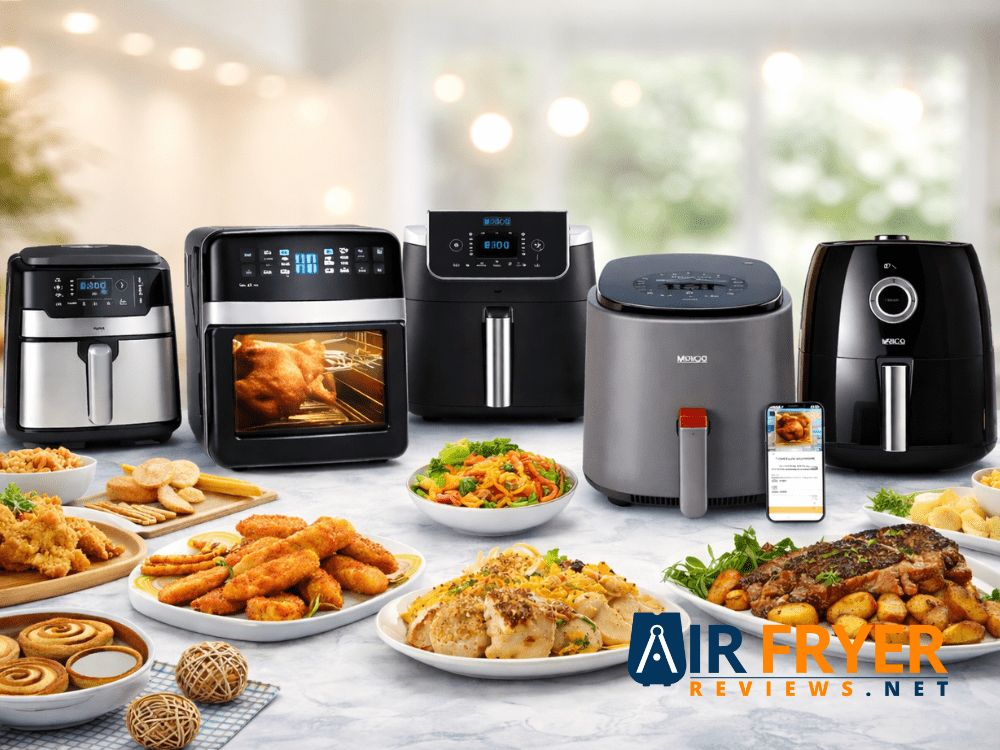

Choosing an air fryer today feels complicated not because there are too few options but because there are too many that look similar while performing differently. Conflicting reviews, overlapping features and unclear specifications often leave buyers whether first-time purchasers or those upgrading uncertain about what truly matters.
The issue isn’t interest. It’s confidence.
Many people struggle to determine the right size, technology and features for everyday cooking.
Time pressure makes the process harder. Comparing technical details, filtering marketing claims and reading mixed feedback can quickly become overwhelming. Instead of focusing on healthier meals and convenience buyers often experience decision fatigue. What should be a practical kitchen upgrade starts to feel unnecessarily stressful.
I created this buying guide to simplify that process.
Every recommendation in this guide is grounded in structured research and real-world testing in my own kitchen using basket-style air fryers. I’ve focused on practical performance how evenly a unit cooks how easy it is to clean how well it holds temperature and how it fits into daily routines. Professional techniques and cooking logic were reviewed with input from contributing chefs to ensure the advice reflects best-practice standards.
This guide prioritizes clarity over trends. You’ll find straightforward explanations, realistic comparisons and clear solutions to common concerns including capacity selection, cooking performance, ease of cleaning and long-term value.
The goal is simple to help you choose an air fryer that fits your kitchen, your routine and your lifestyle so you can cook healthier meals with confidence every day.
Why the Air Fryer Craze? Unpacking the Benefits
An air fryer is a compact countertop appliance designed to cook food by circulating hot air at high speed around the ingredients. This rapid airflow creates a crisp exterior similar to frying while using little to no added oil. Functionally, it operates like a focused convection oven delivering even heat distribution in a smaller faster-heating space.
In simple terms: An air fryer cooks food by rapidly circulating hot air to produce a crispy texture with significantly less oil than traditional deep frying making it a practical option for everyday lower-fat cooking.
The Rise in Popularity: Convenience Meets Health
The growing interest in air fryer benefits reflects how modern kitchens operate today. Home cooks want appliances that save time, reduce cleanup and support healthier eating without requiring advanced techniques.
From a convenience standpoint air fryers:
- Preheat quickly
- Cook faster than conventional ovens
- Handle a wide range of foods from vegetables and proteins to frozen items such as a pot pie
- Use straightforward controls
For busy households this translates into fewer steps and more predictable results.
Health considerations are another key factor. Many people choose air frying because it reduces oil usage while still delivering familiar textures. Lower oil consumption can help support calorie control particularly when compared to deep frying or pan frying methods.
Solving Real Home-Cooking Challenges
In practical terms the appeal of an air fryer lies in everyday usability:
Speed: Faster cooking helps fit home-prepared meals into tight schedules.
Consistency: Even air circulation improves reliability especially for beginners.
Health Awareness: Reduced oil aligns with long-term wellness goals without drastically changing how people eat.
Ease of Use: Simple temperature and time controls lower the learning curve for first-time appliance buyers.
These combined benefits explain why interest in air fryer buying guidance continues to grow. The appliance does not require users to change what they cook it simply changes how efficiently and health-consciously they prepare it.
Core Benefits for Modern Home Cooks
Healthier Cooking Without Compromise
One of the most frequently discussed benefits of an air fryer is its ability to support healthier cooking without requiring major dietary changes. Compared to traditional deep frying an air fryer uses significantly less oil often just a light coating or none at all. This reduction can lower overall fat and calorie intake while still allowing familiar meals to remain part of your routine.
Because of rapid hot-air circulation many foods develop a crisp exterior and satisfying texture like crispy air fryer bacon bits even with reduced fat. In my own testing, I’ve found that simple adjustments such as lightly patting food dry and spacing it properly make a noticeable difference in texture without increasing oil.
Throughout this buying guide health-related points are based on appliance testing, practical results and professional review input rather than marketing claims. The goal is realistic expectations not exaggerated promises.
Unmatched Convenience & Speed
For busy households convenience matters just as much as nutrition. An air fryer supports this by reducing both preparation and cooking time.
- Faster cooking for many everyday dishes compared to ovens
- Quick preheating often ready within minutes
- Straightforward controls that simplify meal prep
In real kitchen use this often means weeknight meals become more manageable. Instead of waiting for a full oven cycle smaller portions cook efficiently in a compact space.
This balance of speed and reliability is one reason many home cooks begin using their air fryer regularly rather than occasionally.
Versatility Beyond Frying
Despite the name an air fryer is not limited to frying-style foods. Its controlled heat and airflow make it suitable for a variety of tasks.
- Roasting vegetables and meats
- Baking small batches such as muffins or cookies
- Reheating leftovers while preserving texture
In my testing, reheating has been one of its most practical strengths. Foods that often turn soft in a microwave regain firmness and structure when reheated with circulating air.
For kitchens with limited space this versatility adds measurable value. A single appliance can handle multiple roles without occupying the space of a full oven.
Addressing Skepticism: Taste, Texture and Realistic Expectations
It’s natural to question whether reduced oil means reduced flavor or texture. These concerns are valid.
An air fryer does not replicate deep frying in every situation. However, when used correctly with proper spacing, preheating and temperature control it consistently delivers crispness and browning that meet everyday expectations.
Professional insights from contributing chefs reinforce an important point satisfaction comes from using the appliance for the right foods and techniques rather than expecting it to replace every traditional method.
My Air Fryer Journey: From Skeptic to Super Fan
When I first considered buying an air fryer I wasn’t immediately convinced. Like many home cooks, I questioned whether it would become just another appliance taking up counter space. The promises sounded strong but I wanted to see how it performed in a real kitchen.
My early attempts were not perfect. I overcrowded the basket expected deep-fryer results on the first try and underestimated how important airflow really is. Some batches browned unevenly and cleanup felt more frequent than I anticipated. At that stage, I understood why some buyers feel uncertain.
The shift happened during a busy weeknight. I prepared Tyson frozen chicken wings with proper spacing and only a light coating of oil. They cooked evenly developed crisp skin and finished much faster than my oven would have allowed. That result wasn’t dramatic it was practical. It fit into my routine without extra effort.
Over time, I began using the air fryer more regularly. It reduced reliance on takeout and helped make weeknight cooking feel manageable again. Professional insights from contributing chefs often reinforce this pattern once users understand airflow, spacing and temperature control results become far more consistent. That matched my experience exactly.
Tips & Tricks I Learned Through Testing
These small adjustments made a noticeable difference:
- Avoid overcrowding. Proper hot-air circulation improves browning and texture.
- Shake or turn food halfway through cooking. This promotes even results.
- Use a light oil coating. Skipping oil entirely can reduce browning on certain foods.
- Clean promptly after use. Preventing residue buildup improves performance and reduces smoke.
None of these steps are complicated but they matter.
Through repeated testing in my own kitchen, I’ve learned that success with an air fryer comes from understanding how it works not from expecting it to behave like a deep fryer. That firsthand experience shapes the advice throughout this guide keeping it grounded in practical everyday use rather than theory.
How Air Fryers Actually Work: The Science of Crispiness
The Magic of Rapid Air Circulation
At the core of how an air fryer works is convection cooking. Inside the appliance a heating element raises the temperature while a high-speed fan circulates that hot air rapidly around the food. This continuous airflow exposes all surfaces to consistent heat which is essential for even browning.
As the hot air moves around the food surface moisture evaporates quickly. When that moisture escapes the exterior firms up and begins to brown. Meanwhile the interior cooks through retained heat helping maintain tenderness.
In practical terms air fryers rely on controlled airflow and stable temperature not oil immersion to create crisp textures.
In simple terms: An air fryer uses a heating element and a high-speed fan to circulate hot air around food creating a crispy outer layer while cooking the inside evenly with minimal oil.
Key Components of an Air Fryer
Understanding the main parts of an air fryer helps explain why performance varies between models and why proper technique matters.
Heating Element: Usually located at the top of the unit, it generates heat quickly. This supports fast preheating and stable cooking temperatures.
Powerful Fan: The fan drives rapid air circulation. Consistent airflow is what enables even cooking and browning across all surfaces.
Cooking Basket or Tray: Most baskets are perforated or mesh-based to allow air to move freely around the food. Proper spacing inside the basket directly impacts crispness and prevents uneven cooking.
Together, these components create the airflow-focused cooking environment that defines air frying.
Debunking Myths: It’s Not a Deep Fryer
A common misconception is that an air fryer duplicates deep frying. The two methods operate very differently.
- Deep frying: Food is submerged in hot oil.
- Air frying: Food is surrounded by circulating hot air.
Air frying produces crispness through surface dehydration and browning, not oil absorption. While the texture can be satisfying and crisp it is created through a different process.
Understanding this distinction sets realistic expectations. When home cooks know what the appliance is designed to do and what it is not results are more predictable and disappointment is less likely.
Comparison Table: Air Fryer Types at a Glance
| Air Fryer Type | Best For | Key Advantages | Potential Drawbacks |
|---|---|---|---|
| Basket-Style | Singles, couples, small kitchens | Compact, quick preheat, often more affordable, simple to use | Limited capacity, usually one cooking zone |
| Oven-Style | Families, larger batches, multi-functional use | Larger capacity, versatile (roast, bake, toast), better visibility | Larger footprint, generally higher price |
| Paddle-Type | Dishes needing constant stirring (e.g., fries) | Hands-off cooking, even browning | Less common, specific use cases can be more expensive |
| Dual-Basket | Cooking multiple items simultaneously | Independent controls, synchronized finish, strong meal-prep convenience | Larger footprint, higher initial cost |
| Multi-Cooker w/ Air Fry | Space-saving, diverse cooking methods | Pressure cook, slow cook, air fry in one unit | Bulkier design, learning curve, airflow may be less optimized |
Understanding these differences makes it easier to match the appliance to your cooking habits. The right choice depends less on brand and more on how you plan to use it daily.
Key Factors to Consider Before Buying: Your Decision-Making Checklist
Selecting the right air fryer becomes much easier when you focus on the factors that directly impact everyday use. In my experience most buying hesitation comes down to four concerns capacity available counter space feature overload and budget clarity.
This checklist focuses on what truly affects long-term satisfaction.
Capacity & Household Size
Capacity confusion is one of the most common reasons buyers feel uncertain. Choosing too small a unit leads to overcrowding while choosing too large a model may waste space and energy.
Understanding air fryer capacity starts with matching the appliance to how many people you cook for and how you prefer to prepare meals.
Compact (1-3 Quarts)
Best for singles, dorm rooms and small apartments such as a Cosori 2.1 Qt mini air fryer.
Works well for modest portions and simple meals.
Mid-Size (4-6 Quarts)
The most practical range for many households.
Well suited for couples or families of 2-4 people.
Offers flexibility without dominating the countertop.
Large (7+ Quarts)
Ideal for larger families, batch cooking or entertaining.
Better suited for preparing full meals rather than single items.
Through testing, I’ve found that advertised capacity doesn’t always equal usable cooking space. For consistent crisping food should still be arranged in a single layer. Contributing chefs consistently reinforce that airflow not just basket volume determines cooking quality. Overcrowding reduces performance regardless of size.
Wattage, Power & Performance
Wattage directly influences how an air fryer performs.
Higher wattage models generally:
- Preheat more quickly
- Maintain temperature more consistently
- Deliver more stable browning
Performance differences are especially noticeable in larger-capacity units where maintaining steady heat becomes more demanding.
From an energy perspective air fryers can be more efficient than traditional ovens for small to medium meals. Because they heat a smaller chamber and cook faster they often use less electricity per session.
All technical points in this guide are based on manufacturer specifications and documented appliance performance data rather than marketing claims.
Temperature Range & Control
Temperature control affects how accurately and flexibly you can cook. The wider and more stable the temperature range, the easier it is to adapt the appliance to different foods and techniques.
Most air fryers operate between approximately 180°F and 400°F (80°C to 200°C). What matters more than range alone is how precisely the unit maintains that temperature.
Digital vs. Analog Controls
Digital Controls:
- Allow precise time and temperature adjustments
- Often include pre-set programs
- Useful for consistent repeatable results
Analog Controls:
- Operate with simple dials
- Less precise but straightforward
- Suitable for users who prefer simplicity
In daily use, I’ve found precision helpful when fine-tuning results. Professional insights from contributing chefs also emphasize the value of manual temperature adjustments for achieving consistent browning.
Pre-Set Functions vs. Manual Control
Pre-sets add convenience for common items such as fries, chicken or frozen breaded fish. However, relying entirely on presets can limit flexibility.
Manual control allows you to:
- Adjust for food thickness
- Compensate for portion size
- Modify recipes
- Experiment confidently
Prioritizing manual control even when presets are available supports more adaptable real-world cooking.
Size & Counter Space
Before purchasing consider the appliance’s physical footprint not just capacity.
Footprint: Measure available counter space. Ensure there is room for airflow clearance.
Height: Check cabinet clearance, especially for oven-style models with front-opening doors.
Selecting the right size prevents daily inconvenience and reduces the need to constantly move the unit.
Noise Level
Air fryers rely on powerful fans and some models operate louder than others.
If noise matters in your kitchen:
- Review product specifications
- Look for user feedback mentioning sound levels
Quieter models often feature improved airflow design or insulation though performance should not be sacrificed for silence.
Safety Features
Reliable safety features contribute to long-term confidence especially in households with frequent use.
Look for:
- Automatic shut-off
- Overheat protection
- Cool-touch exterior
- BPA-free food-contact materials
These features support safe everyday operation.
Ease of Cleaning
Cleaning difficulty directly affects how often the appliance gets used.
Dishwasher-Safe Components
Removable baskets and trays that fit in the dishwasher simplify maintenance.
Non-Stick Coatings
Quality coatings reduce food sticking and make hand-washing faster.
Thoughtful Design
Smooth interiors and minimal crevices prevent grease buildup.
In my experience easy cleanup significantly increases long-term satisfaction. Contributing chefs consistently note that appliances that are simple to clean are used more frequently.
Budget & Value for Money
Understanding price tiers helps align expectations with actual needs.
Entry-Level Models:
- Basic controls
- Smaller capacity
- Suitable for occasional use
Mid-Range Models:
- Balanced features and capacity
- Strong overall value for most households
Premium Models:
- Larger capacity
- Advanced features
- Often improved build quality
True value includes durability consistent performance, and warranty support not just the initial price.
Durability, Build Quality & Warranty
Build quality influences lifespan.
Materials: Stainless steel components and sturdy baskets often indicate stronger durability than lightweight plastics.
Brand Reputation: Customer support and product longevity patterns matter as much as specifications.
Warranty Coverage: A solid warranty reflects manufacturer confidence and provides reassurance.
These elements help distinguish short-term savings from long-term reliability.
Smart Features & Connectivity (Optional)
Smart features can add convenience but they are not essential.
App Control:
- Remote monitoring
- Recipe integration
- Notifications
Voice Assistant Compatibility:
- Smart home integration
- Hands-free operation
Before prioritizing connectivity consider whether it supports your routine or adds unnecessary complexity. In many kitchens, reliable manual control remains the most practical choice.
The Air Fryer Problem Solver: Quick Fixes for Common Frying Frustrations
Even with the right model, challenges can happen. In my own testing, most issues are not caused by the appliance itself but by airflow, temperature control or small technique gaps. The good news is that these problems are usually easy to fix.
Below are common frustrations and practical solutions you can apply immediately.
Problem: “My Food Isn’t Crispy!”
Lack of crispiness is almost always related to airflow, temperature or surface moisture.
What Works:
- Preheat for 3-5 minutes. Starting in a hot environment supports immediate browning for foods like frozen bacon.
- Avoid overcrowding. Cook in a single layer so hot air circulates freely.
- Shake or flip halfway through cooking. This promotes even texture.
- Use a light oil spray. High smoke-point oils like avocado or grapeseed improve browning without adding excessive fat.
Through repeated testing, I’ve found that crisp results depend more on technique than on price. Contributing chefs consistently reinforce that airflow management makes the biggest difference.
Problem: “It’s Smoking!”
Smoke usually comes from excess grease or leftover residue.
What Works:
- Clean after every use. Once cool, wipe down the basket and interior.
- Manage fatty foods carefully. Use a drip tray if available or absorb excess grease.
- Check near the heating element. Remove grease buildup regularly.
These steps reduce smoke, odors and long-term performance issues.
Problem: “It’s Hard to Clean!”
Cleaning frustration often results from delayed maintenance.
What Works:
- Use perforated parchment or silicone liners. They ease cleanup without blocking airflow.
- Clean while parts are warm (not hot). Residue removes more easily.
- Soak stubborn buildup. Warm soapy water works better than aggressive scrubbing.
When cleaning becomes routine the appliance remains convenient instead of becoming neglected.
Problem: “Uneven Cooking!”
Uneven results are usually caused by restricted airflow or insufficient movement.
What Works:
- Leave space between pieces. Air circulation is essential.
- Shake or flip more than once if needed. Denser foods benefit from additional movement.
- Understand your model. Some units require full manual shaking others rotate internally.
Professional insights consistently note that movement is especially important for thicker or denser foods.
Problem: “Food Is Dry or Overcooked!”
Overcooking often happens when oven recipes are transferred directly without adjustment.
What Works:
- Reduce temperature slightly. Air fryers cook more efficiently than ovens.
- Shorten cook time. Check early and adjust gradually.
- Use a thermometer for proteins. This prevents guesswork.
- Apply a light oil spray. Helps maintain surface moisture.
Balancing heat and timing preserves both texture and moisture.
Problem: “It Takes Up Too Much Space!”
Counter space is a legitimate concern.
What Works:
- Choose a compact basket-style model if space is limited.
- Consider multi-function units if you want to consolidate appliances.
- Measure before purchasing to avoid daily inconvenience.
Selecting the right size prevents frustration later.
Cleaning and Maintenance Guide: Keep Your Air Fryer Spotless
Concern about cleaning time often discourages regular use. In practice, consistent maintenance makes cleaning faster and protects long-term performance. When I test air fryers regularly I’ve found that small daily habits prevent nearly all major buildup issues.
Why Regular Cleaning Is Crucial
Hygiene
Removing grease and food particles prevents bacterial growth, smoke and lingering odors.
Longevity
Routine cleaning helps extend the lifespan of your air fryer by preventing residue from straining internal components or blocking airflow.
Performance
Clean baskets and unobstructed vents ensure proper hot-air circulation which directly affects crispness and even cooking.
In real-world evaluations contributing chefs consistently note that most performance complaints stem from neglected cleaning rather than mechanical defects.
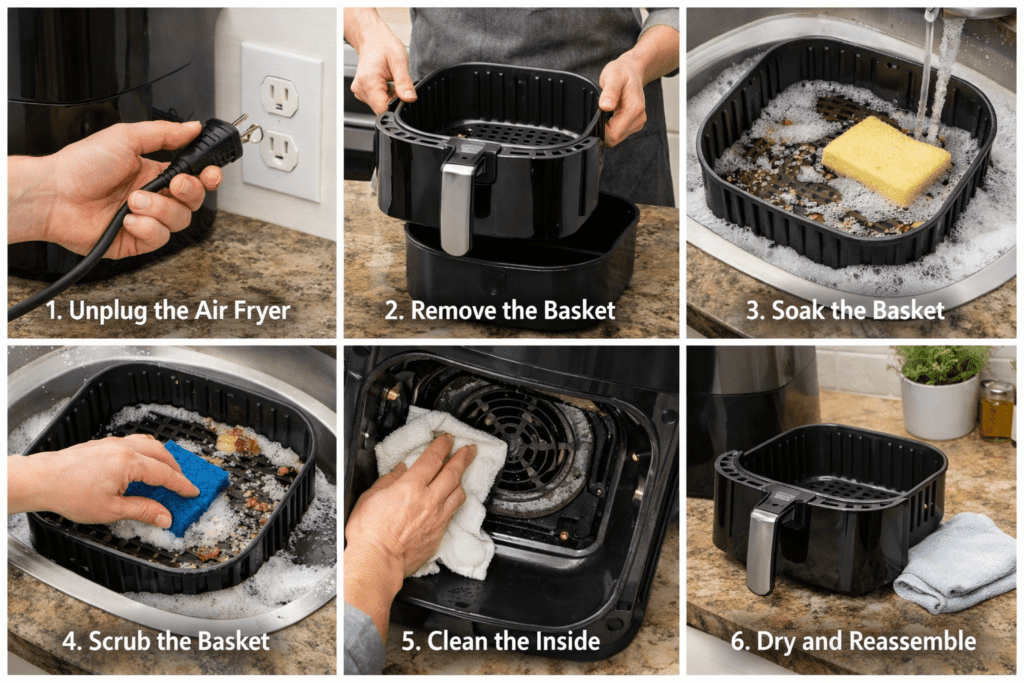
Step-by-Step Cleaning Process
Step 1: Unplug and Cool Down
Always unplug the air fryer and allow it to cool completely before cleaning. This prevents burns and protects electrical components.
Step 2: Wash Removable Parts
- Remove the basket, tray and racks.
- Wash with warm, soapy water.
- If manufacturer-approved, place parts in the dishwasher.
- Use non-abrasive sponges to protect non-stick coatings.
Step 3: Wipe Down Interior and Exterior
- Use a damp cloth to clean the interior cavity.
- Wipe the exterior casing to remove grease and fingerprints.
- For stubborn grease use a mild kitchen-safe degreaser.
Step 4: Deep Cleaning (When Needed)
- Soak heavily soiled parts in hot soapy water for about 30 minutes.
- Use a soft brush to loosen residue.
- Check near the heating element (when cool) and gently wipe away buildup.
Practical Tip: Cleaning shortly after cooking once the unit has cooled prevents residue from hardening and becoming difficult to remove.
Cleaning Don’ts: What to Avoid
Never submerge the main unit containing electrical components in water.
Avoid metal scrubbers or abrasive cleaners that can damage non-stick surfaces.
Do not use oven cleaner inside the air fryer unless explicitly approved by the manufacturer.
Avoid spraying cleaning liquids directly into vents or electrical openings.
Consistent maintenance keeps cleaning manageable and ensures your air fryer remains efficient, hygienic and reliable.
Essential Air Fryer Accessories to Enhance Your Cooking
The right accessories can significantly expand what your air fryer can do. In my own kitchen testing, I’ve found that a small thoughtful set of tools makes a bigger difference than buying the most expensive model.
Contributing chefs consistently recommend choosing purpose-built accessories designed specifically for air fryers. These tools enhance versatility without complicating your workflow.
Perforated Parchment Paper & Silicone Liners
Benefits:
- Simplify cleanup and reduce grease buildup
- Prevent food from sticking to baskets or trays
Important: Always use liners with perforations. Airflow is critical to crispness and blocking circulation reduces performance.
Racks & Skewers
Benefits:Benefits:
- Enable multi-layer cooking
- Ideal for kebabs, vegetables, or small portions
- Maximize vertical cooking space
Racks are especially useful in larger-capacity or oven-style models where height can be used efficiently.
Baking Pans & Muffin Cups (Air Fryer Safe)Baking Pans & Muffin Cups (Air Fryer Safe)
Benefits:
- Expand beyond frying
- Suitable for cakes, muffins, small casseroles and stuffed items
Material Considerations:
- Silicone: Flexible and easy release
- Ceramic: Even heat distribution
- Metal: Crisp edges and stronger browning
Always confirm the material is labeled air fryer safe.
Oil Sprayers or Misters
Benefits:
- Distribute oil in a fine even layer
- Improve browning and texture
- Reduce unnecessary oil usage
High smoke-point oils such as avocado or grapeseed perform best for consistent results.
Grill Pans & Grates
Benefits:
- Create grill-style markings
- Allow fat to drain away
- Improve texture for proteins
These are particularly useful for higher-fat foods where drainage improves browning.
Internal Meat Thermometer
Benefits:
- Ensures food safety
- Prevents overcooking
- Removes guesswork from timing
In my experience a thermometer is one of the most valuable tools you can own. Time estimates vary by thickness and model but internal temperature confirms doneness accurately every time.

Top Air Fryer Recommendations for Every Need
These recommendations are based on consistent evaluation standards:
- Cooking performance (evenness, crispiness, repeatability)
- Ease of use (controls, presets, cleaning)
- Safety features
- Durability and build quality
- Capacity and space efficiency
- Overall value for money
Final selections reflect structured market research aggregated user feedback and practical testing comparisons across basket, dual-basket, oven-style and multi-functional units. Professional input during review focused on airflow efficiency, basket usability and consistency across repeated cooking cycles not just specification sheets.
Affiliate relationships, if applicable are transparently disclosed in the full article.
Curated List of Highly-Rated Air Fryers
- Best Overall Performer: Cosori Pro II
- Best Budget-Friendly Option: Ultrean Air Fryer
- Best Large Capacity for Families: Ninja Foodi 10-in-1 Smart XL
- Best Compact for Small Spaces: Philips Essential Airfryer Compact
- Best Dual-Basket for Efficiency: Ninja Foodi Dual Zone
- Best Multi-Functional (Oven-Style): Instant Omni Plus 10-in-1
Each model addresses a specific buyer concern whether it’s limited counter space, cooking for a large household, budget restrictions or wanting multiple cooking functions in one appliance.
Comparison Table: Top Air Fryer Models
| Model | Type | Capacity | Key Features | Best For | Pros | Cons | Price Range |
|---|---|---|---|---|---|---|---|
| Cosori Pro II | Basket | 5.8 Qt / 5.5 L | 12 functions, rapid preheat, shake reminder | Small families | Consistent crisping, intuitive controls | Basket shape limits oversized foods | Moderate |
| Ninja Foodi 10-in-1 Smart XL | Multi-functional | 8 Qt / 7.6 L | Smart thermometer, 10 functions | Large families | High versatility, strong precision | Bulky, premium cost | Premium |
| Instant Vortex Plus 6-in-1 | Basket | 6 Qt / 5.7 L | ClearCook window, EvenCrisp tech | Everyday cooking | Visual monitoring, easy cleanup | Window needs frequent cleaning | Moderate |
| Ninja Foodi Dual Zone | Dual-Basket | 8 Qt / 7.6 L | Independent baskets, Smart Finish | Meal prep flexibility | Cook two foods at once | Large footprint | Premium |
| Philips Essential Compact | Basket | 4.1 Qt / 3.9 L | Rapid Air tech, compact build | Singles/couples | Durable build, reliable heat | Smaller capacity | Moderate–Premium |
| Ultrean Air Fryer | Basket | 4.2 Qt / 4 L | LCD display, 7 presets | Budget buyers | Affordable, beginner-friendly | Less durable materials | Budget |
| Instant Omni Plus 10-in-1 | Oven-Style | 26 L | 10 functions, interior light | Multi-purpose cooking | Excellent baking/toasting | Larger counter space needed | ModeratePremium |
How to Choose from This List
- If you want balanced performance and ease of use the Cosori Pro II offers strong everyday value.
- If you’re working with a tight budget the Ultrean delivers entry-level functionality without unnecessary extras.
- If you cook for four or more people regularly large-capacity or dual-basket models reduce batch cooking.
- If your kitchen space is limited a compact basket model minimizes footprint while maintaining performance.
- If you prefer a single appliance to handle multiple cooking methods an oven-style multi-function unit may be more practical.
The goal isn’t to buy the most advanced model it’s to match the appliance to how you actually cook. Capacity, space and daily routine matter more than feature count alone.
Air Fryer FAQs: Your Questions Answered & Myths Debunked
This section addresses common concerns that cause hesitation health questions feature confusion and fear of making the wrong purchase using practical evidence-based explanations grounded in real kitchen use.
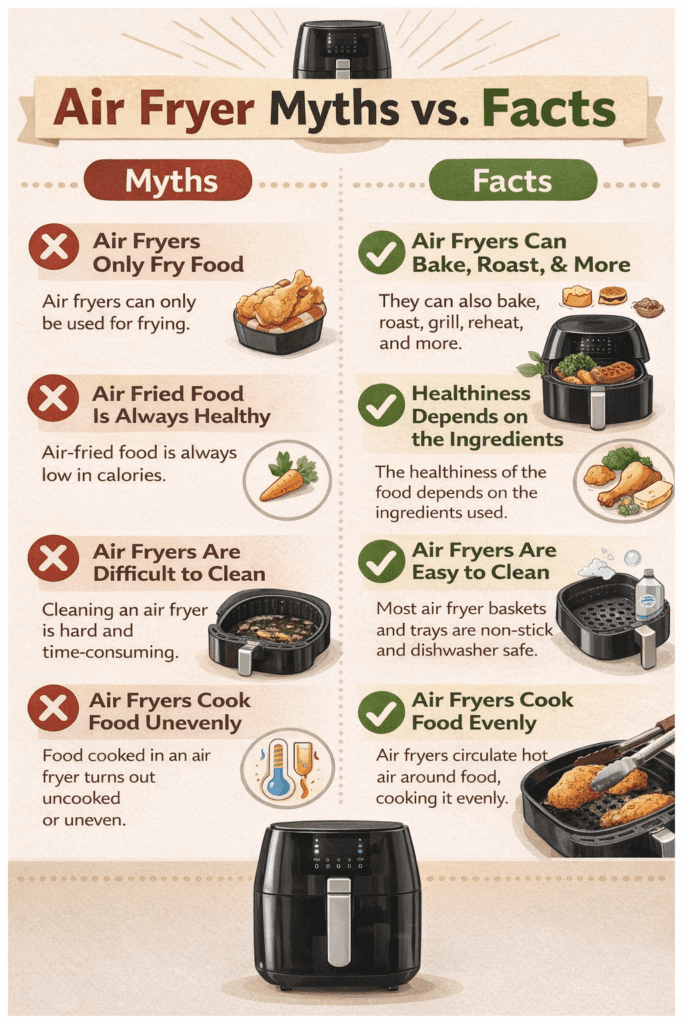
Is Air-Fried Food Really Healthier?
Short Answer: It can be depending on what and how you cook.
Air frying typically uses far less oil than deep frying which can reduce overall fat and calorie intake. Lowering added fats is widely associated with improved heart health and better weight management.
However, “healthier” isn’t automatic. Nutrition still depends on:
- Ingredients
- Portion sizes
- Preparation methods
Air-fried vegetables and lean proteins offer very different outcomes compared to heavily processed frozen foods. The appliance supports healthier cooking but food choices still matter.
Does Air-Fried Food Taste as Good as Deep-Fried?
Air-fried food delivers a crisp, browned texture but without oil saturation. The result is lighter and less greasy.
Contributing chefs often describe air frying as a health-forward alternative not a direct replacement for deep frying. When expectations are realistic and seasoning is properly balanced most home cooks find the taste difference acceptable and often preferable for everyday meals.
Can I Put Aluminum Foil or Parchment Paper in an Air Fryer?
Yes with proper use.
- Use foil sparingly.
- Never block airflow completely.
- Keep foil away from the heating element.
- Choose perforated parchment or silicone liners designed for air fryers.
Important: Airflow is the foundation of crispness. Any accessory should support circulation not restrict it.
What Foods Can’t You Cook in an Air Fryer?
Certain foods are less suitable due to airflow dynamics:
- Wet, loose batters
- Foods with excessive loose seasoning
- Large amounts of exposed cheese
These can drip, burn or create unnecessary mess without delivering quality results.
Do I Need to Preheat My Air Fryer?
In most cases, yes.
Preheating for 3-5 minutes helps stabilise temperature and promotes even browning. This is especially important for:
- Proteins
- Frozen foods
- Foods where crisp texture matters
Skipping preheat often leads to uneven results.
How Long Do Air Fryers Last?
Most quality air fryers last 3-5 years or longer with proper care.
Lifespan depends on:
- Build quality
- Frequency of use
- Cleaning habits
- Avoiding overheating
Routine maintenance significantly extends durability.
Is an Air Fryer Worth It for a Single Person or Small Household?
Yes often more so.
Benefits for small households include:
- Better portion control
- Faster cooking than full-size ovens
- Minimal cleanup
- Compact design options
Basket-style models are especially practical for apartments or dorm kitchens.
What’s the Difference Between an Air Fryer and a Convection Oven?
Both use circulating hot air but they differ in design and purpose.
| Feature | Air Fryer | Convection Oven |
|---|---|---|
| Size | Compact | Larger |
| Speed | Faster preheat & cook time | Slower |
| Efficiency | Ideal for small meals | Better for large batches |
| Daily Use | High convenience | More traditional cooking |
A convection oven offers capacity. An air fryer offers speed and focused airflow.
How Do I Adapt My Favorite Recipes for the Air Fryer?
Recipe conversion is one of the most common concerns.
General Guideline:
- Reduce oven temperature by 25°F
- Reduce cook time by about 20%
- Check food early
- Shake or flip midway
- Use a thermometer for proteins
I recommend adjusting gradually. Air fryers cook more efficiently than conventional ovens so small timing differences can significantly affect texture.
Conclusion: Making Your Final Decision with Confidence
Choosing the right air fryer ultimately comes down to understanding what matters most in your kitchen. Throughout this guide the focus has remained on the factors that genuinely influence everyday satisfaction capacity, type, controls, cleaning ease durability and budget.
There is no universally perfect model. The best air fryer is the one that fits your cooking habits space limitations and daily routine. A compact basket model may be ideal for a single cook while a dual-basket or oven-style unit can better support a larger household preparing multiple dishes at once.
Choose What’s Right for You
Confidence comes from clarity.
Start by identifying your primary pain points:
- Limited counter space
- Cooking for multiple people
- Wanting faster weeknight meals
- Reducing oil use
- Simplifying cleanup
Once those priorities are clear the decision becomes much easier. This buying guide is designed to help you compare realistically not chase features you may never use.
In my own testing, satisfaction always comes down to alignment between the appliance and actual cooking habits. When expectations match function the air fryer becomes a practical tool rather than a source of frustration.
Final Encouragement
An air fryer is not a trend-driven gadget it’s a convenience appliance that can simplify healthy everyday cooking when chosen thoughtfully. With the right model it becomes part of your routine instead of sitting unused on the counter.
The recommendations in this guide are grounded in structured research, side-by-side comparisons and real kitchen testing. Professional insights were reviewed to validate cooking logic and airflow performance ensuring the advice remains balanced and practical.
As a Final Reminder:
- Always place your air fryer on a heat-resistant surface.
- Leave adequate clearance around the unit for ventilation.
- Avoid pushing it directly against walls or cabinets.
Proper placement ensures safe operation and protects both your appliance and your kitchen.
